STASISLAYER™ STRUCTURAL SYSTEM
Why does the center fail first?
Most mattresses feel supportive when you buy them. The question is what happens to that support after a year of sleeping in the same spot, in the same position, every night.
StasisLayer™ System is Manchot's structural approach to that problem — built around where body weight actually concentrates, not where it's easiest to add material.

Support doesn't collapse overnight. It gives way gradually — and it almost always starts in the middle.
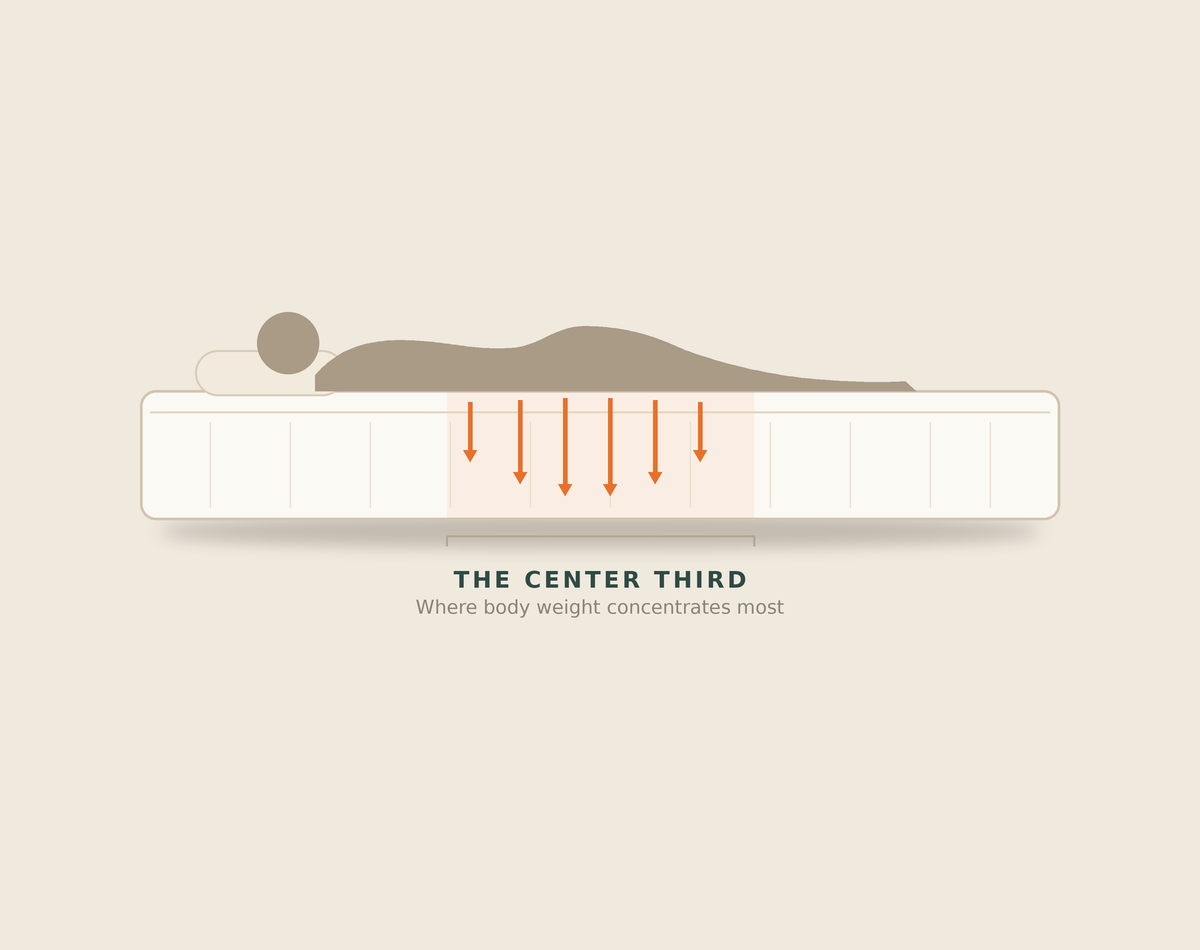
Why the center carries more load than anywhere else
Body weight concentrates in the center third of the mattress during sleep, making it the first area to lose structural support over time. The reason is plain anatomy: the torso and pelvis make up roughly half of total body mass, and studies of supine pressure distribution consistently find the highest contact pressure under the pelvis — which sits in the center third of the mattress. That's the same spot, under the same load, every night for years.
Repeated compression in that area is what changes the structure over time. The center third handles more of it than any other part of the mattress — which is why it's the first place support begins to shift.
¹ Body-segment mass: Dempster (1955); de Leva (1996); Winter, Biomechanics and Motor Control of Human Movement.
² Supine pressure distribution: PMC, "Biomechanical effects of a lumbar support in a mattress"; PMC, "Effect of Body Composition on Supine Pressure Distribution in Bed."
Why most mattresses use the same structure across the whole surface
Why most mattresses use the same structure across the whole surface
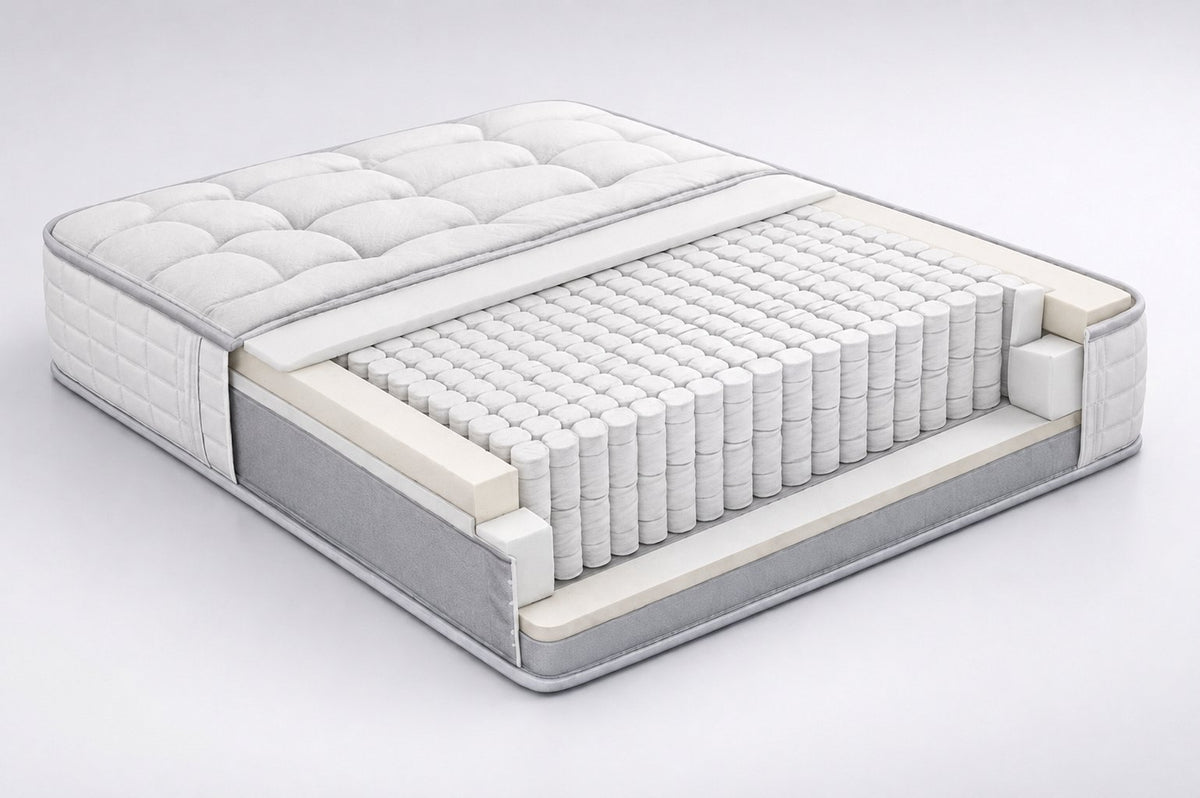
Most mattresses are built with consistent foam density and coil gauge from edge to edge. The center gets the same structure as the perimeter, even though it carries significantly more load.
This isn't a material quality issue. It's a design assumption — that the surface should feel uniform, because a uniform surface is easier to produce and easier to describe in a showroom.
The problem is that the body doesn't load the mattress uniformly. Designing for a uniform feel means the area that works hardest has no additional structural support to draw on.
How StasisLayer™ System approaches the center third differently
Most mattresses respond to center sag by either ignoring it, or by adding more of the same — more coils, denser foam, thicker covers.
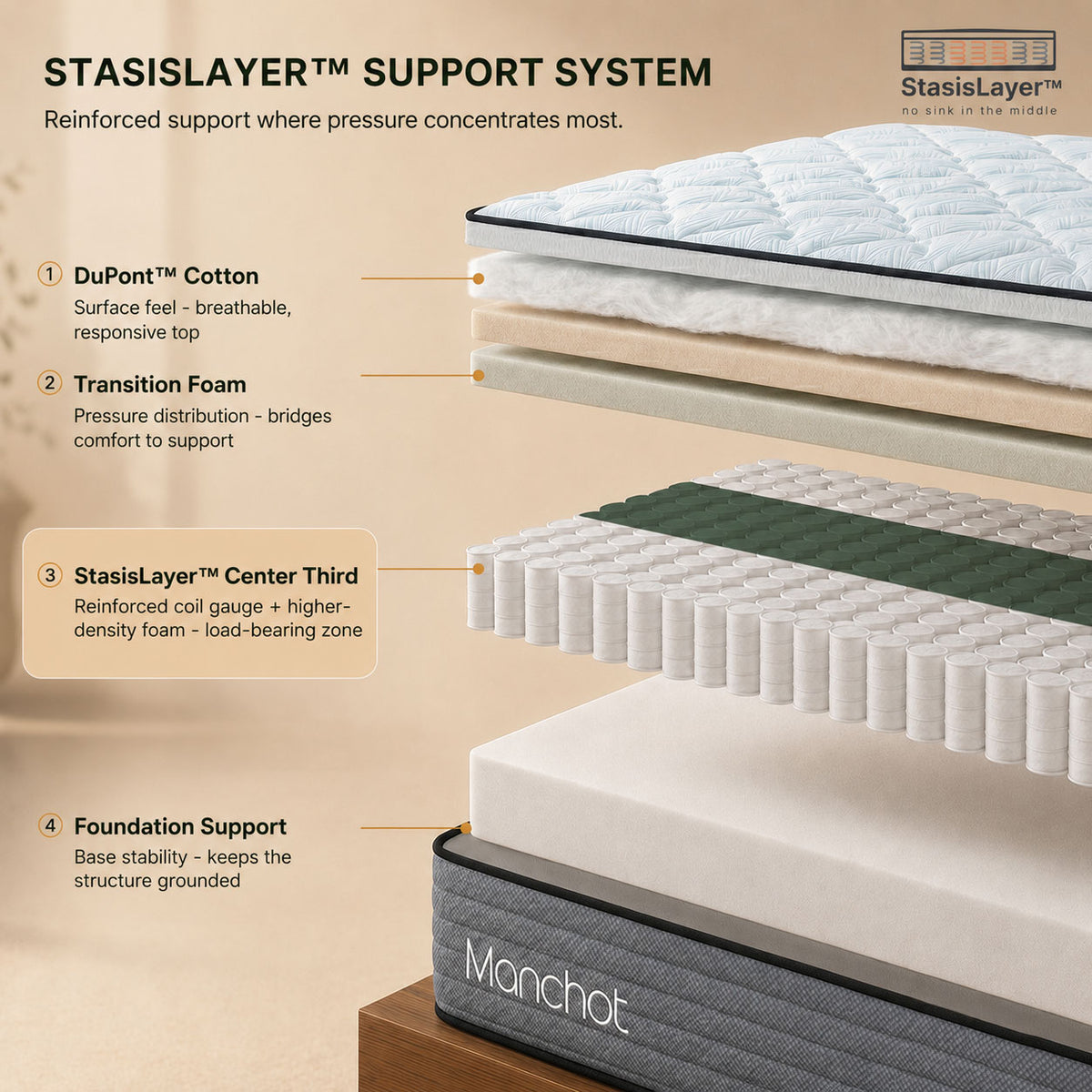
StasisLayer™ System takes a different approach. The center third is engineered as a complete system: the material choice, the structural combination, and the calibration between layers.
This isn't a single feature. It's a three-part engineering decision.
The physics of metal fatigue
StasisLayer™ System is reinforced center support engineered into the center third of the mattress — the zone that carries the body's heaviest load and loses support first. It uses heavier-gauge tempered steel and matched foam density so the highest-load area resists fatigue instead of failing first.
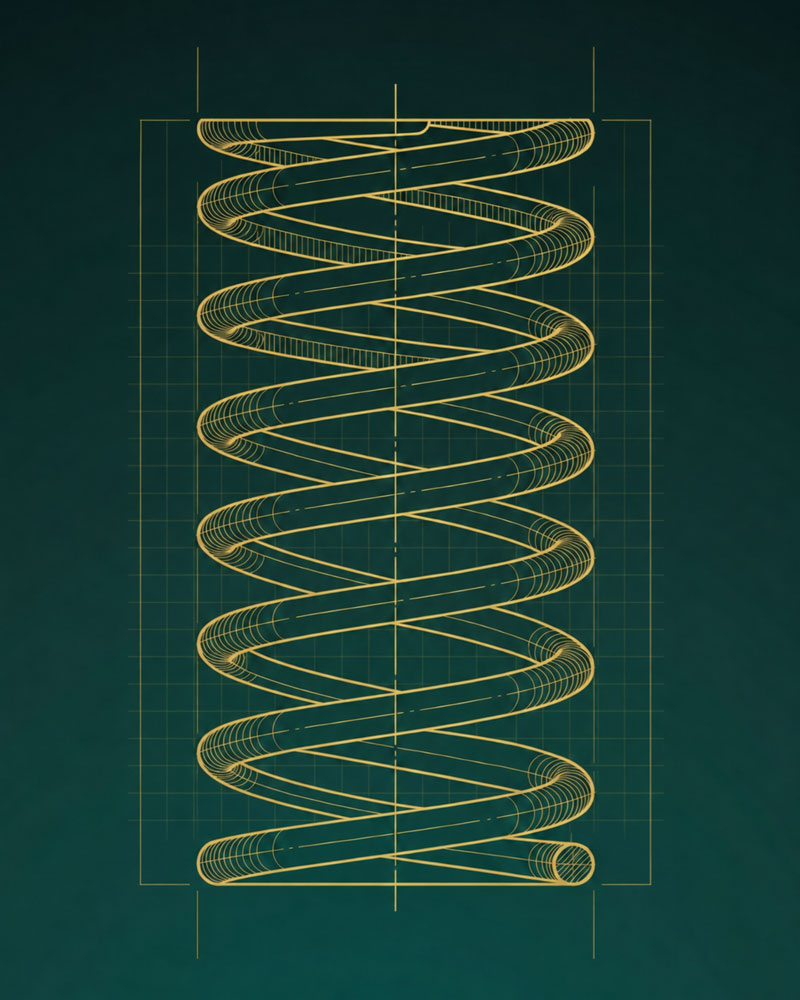
Every coil spring loses tension over time. The process is called metal fatigue — repeated compression creates microscopic cracks in the steel that grow with use. After enough cycles, the spring no longer returns to its original form. The mattress sags, even though nothing looks broken.
Two factors decide how quickly this happens: the gauge of the wire (thicker resists fatigue longer) and the quality of the steel itself. A 1,200-coil mattress made with thin wire looks impressive on paper, but it can fatigue faster than an 800-coil mattress made with thicker, higher-grade steel.
We chose the latter. StasisLayer™ System uses heavier-gauge tempered steel in the center third — wire engineered for fatigue resistance, not for spec-sheet headlines.
The center is where the highest load lives. The material has to be built for that.
Three layers, working together
The engineering isn't in any single part
Think of mattress structure the way a chassis engineer thinks about a car. A great chassis isn't one part — it's the suspension, the frame, and the dampers, all calibrated to work as one. Replacing any single part doesn't make the system better. The whole has to be redesigned together.
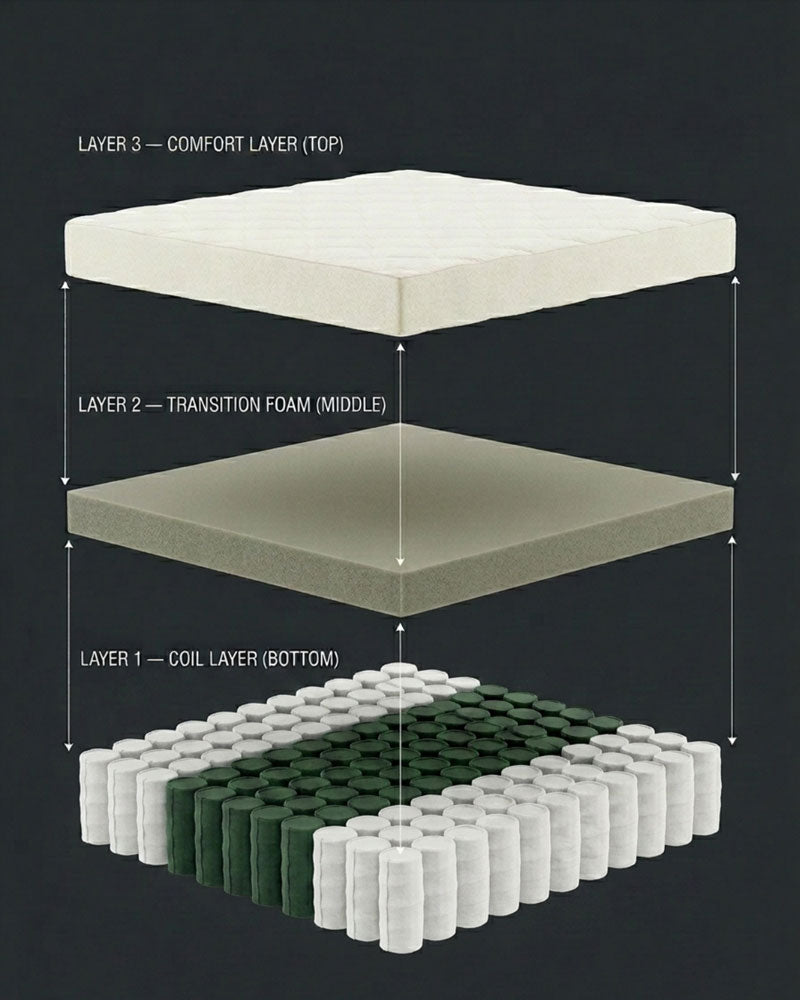
StasisLayer™ System works the same way. The center reinforcement is three layers operating in coordination:
- The coil layer (heavier-gauge wire, denser arrangement)
- The transition foam (engineered density matched to the coil response)
- The comfort layer (calibrated to keep surface feel consistent above the reinforced zone)
Each layer is designed around the others. Change the coil gauge alone, and the foam above it feels wrong. Change the foam alone, and the support shifts. Engineering happens at the relationship between layers, not within any single one.
A chassis isn't built from the best parts. It's tuned as one system.
The engineering between the parts
Where most brands stop, we calibrate
In structural engineering — bridges, buildings, support beams — load distribution isn't guessed. It's calculated, simulated, then tested under cycle after cycle until the response curve matches the design intent.
Mattress engineering follows the same logic, but most brands stop at "we added support where it's needed." The actual tuning — how the foam densities match the coil response, how the transition layers handle pressure return, how the system behaves under five years of compression — that's where the work sits.
StasisLayer™ System is tuned, not just assembled. The center third is calibrated against a single design goal: the surface should feel the same on night one hundred as it does on night one.
Reinforcement is a structural decision. Tuning is what makes it last.
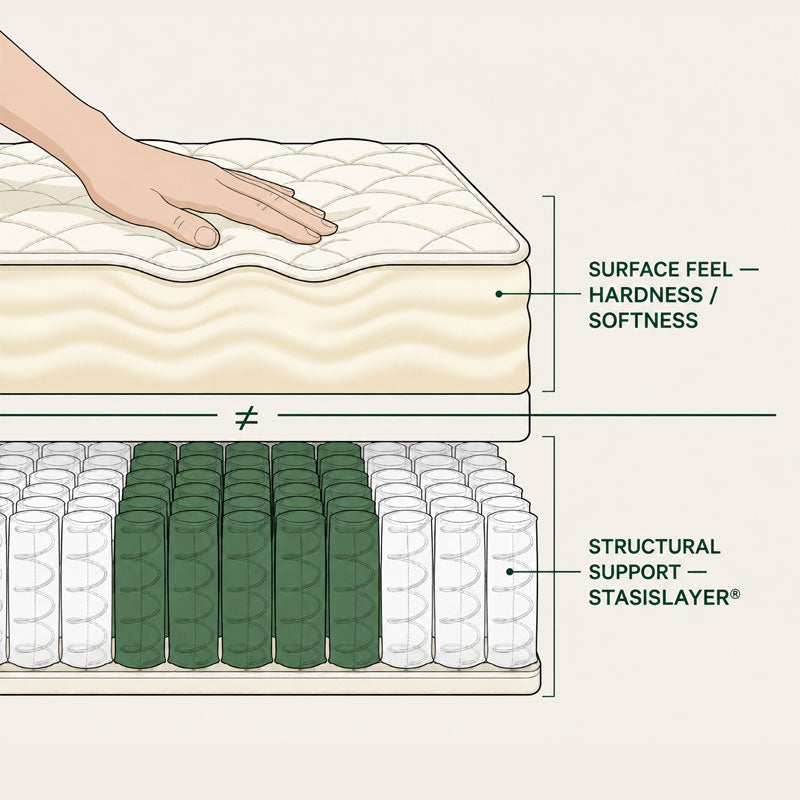
Support ≠ Hardness
These are two separate things, controlled by different parts of the mattress. StasisLayer™ System addresses the structural layer — not the surface feel.
What StasisLayer™ System actually does
Body weight concentrates in the center third of the mattress during sleep, making it the first area to lose structural support over time. StasisLayer™ System is reinforced center support built into that zone — higher coil gauge and increased foam density where the load concentrates.
StasisLayer™ System reinforces the center third specifically — using higher coil gauge and increased foam density in the load-bearing zone.
Reinforcement is a structural decision, not a surface one. It doesn't change how the mattress feels to lie on — it changes how long that feel is maintained.
Want to understand the physics behind center sag? Read: Why Mattresses Sag in the Middle →
Q&A
What is StasisLayer™ System?
What is StasisLayer™ System?
It's Manchot's reinforced center support — heavier-gauge tempered steel and matched foam density built into the center third, the zone that carries the most load and loses support first.
How is it different from just adding more coils?
How is it different from just adding more coils?
More coils don't help if the wire is thin. StasisLayer™ uses heavier-gauge tempered steel where the load concentrates, tuned as a system — coil, transition foam, and comfort layer calibrated together.
Does it stop a mattress from sagging?
Does it stop a mattress from sagging?
It delays it. Reinforcing the center third resists the fatigue that makes the middle fail first, so support holds far longer — not forever, but well past the timeline a uniform build sets.
Does reinforced center support change how the mattress feels?
Does reinforced center support change how the mattress feels?
No. It's a structural decision, not a surface one. It doesn't change how the mattress feels to lie on — it changes how long that feel is maintained.